
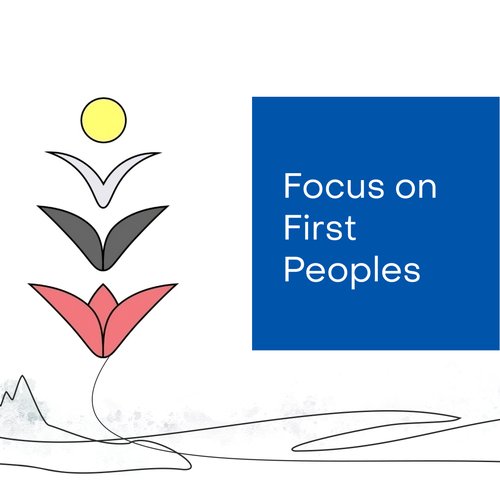
Focus on First Peoples
Réf. FFP

- Durée : 4 heures
- Effort : 4 heures
- Rythme : À votre rythme
This online course aims to inform you and give you the tools to better understand who the First Nations, Inuit and Métis peoples are, what their realities are, and how to contribute to reconciliation and decolonization in various areas, including education.
Aucun cours ouvert
Description
Ce cours est également disponible en français.
This online course offers a basic introduction to the historical and current realities of Indigenous Peoples in Canada ? First Nations, Inuit, and Métis ? and aligns with the objectives of the University of Montreal's new action plan Place aux Premiers Peuples 2024–2028.
The training recognizes and respects the important distinctions between these different nations, and also highlights some essential facts about their history, identities, ways of life, and current living conditions. It identifies persistent inequalities and forms of discrimination, including the systemic discrimination that Indigenous people face on a daily basis.
Whether or not these issues are familiar to you, the course Focus on First Peoples will help you better understand their systemic nature and how deeply rooted they are in structures, systems and history. You will also deepen your knowledge of concepts such as discrimination, systemic racism, epistemic injustice and intersectionality as they relate to the history of First Nations, Inuit and Métis peoples in Quebec and Canada.
Finally, this online course presents cultural safety and its various dimensions: feeling seen, safe and supported. Throughout this course, you will be invited to reflect on how to move forward from a reconciliation and decolonization perspective in academic settings and beyond.
By the end of the training, you will feel more confident in your knowledge of First Nations, Inuit, and Métis peoples, and in the positive impact you can have on creating safer environments for Indigenous people.
Target Audience
This online course was created to inform members of the Université de Montréal community, whether students, teachers or other employees, and to give them tools to better understand who the First Nations, Inuit and Métis peoples are, what their realities are, and how to make a positive impact in academic settings in a spirit of reconciliation and decolonization.
Course Content
This course consists of two modules featuring a variety of activities. Each module can be completed at your own pace.
- Module 1: In this first module, you will learn more about the realities of First Nations, Inuit, and Métis in Québec and Canada and gain a better understanding of the distinctness and diversity of the various Indigenous Nations on this land. We will also examine the many challenges currently faced by Indigenous people and communities and consider how these are rooted in history, as well as in various contemporary social structures.
- Module 2: In this module, we will take a more in-depth look at some of the factors that contribute to perpetuating inequities, including systemic racism. We will also consider how non-Indigenous people can make a difference by contributing in concrete ways to improving Indigenous people’s experiences of universities and other institutions.
Certificate
The online course Focus on First Peoples is free and open to anyone interested.
To obtain a certificate of participation, you must have completed both training modules and pass the final assessment with a minimum score of 70%.
Sessions de cours
Équipe pédagogique

Pullen Sansfaçon, Annie
Catégories
Professeure titulaire, École de travail social, Université de Montréal

Rainville, Samuel
Catégories
Conseiller principal aux relations avec les Premiers Peuples | Vice-rectorat à la planification et à la communication stratégique, Université de Montréal

Bacon, Leticia-Uasheiau
Catégories
Assistante technique | Vice-rectorat à la planification et à la communication stratégique, Université de Montréal

Daméus, Kétura
Catégories
Assistante technique | Vice-rectorat à la planification et à la communication stratégique, Université de Montréal
With the participation of:
Joséphine Bacon
Innu poet
Johnny Boivin
Communications Co-ordinator | RÉSEAU, Montreal Indigenous Community Network
Bréanne Dondo
Law Student | Faculty of Law, Université de Montréal
Sandro Échaquan
Assistant Clinical Professor | Faculty of Nursing, Université de Montréal
Coralie Niquay
PhD student in Public Health | School of Public Health, Université de Montréal
Donald Tolley
Student in Occupational Health and Safety | Faculty of Continuing Education, Université de Montréal
Meygan Tolley
Marketing Manager | Ausgang Plaza
Project co-ordination and techno-pedagogical design
Claude-Eve Dubuc
Techno-pedagogical Consultant | Centre for University Pedagogy, Université de Montréal
Media Design
Francis Brosseau
Media Designer | Centre for University Pedagogy, Université de Montréal
Philippe Léonard
Media Designer | Centre for University Pedagogy, Université de Montréal
Raphaël Renoncourt
Media Designer | Centre for University Pedagogy, Université de Montréal
Quality Assurance
Caroline De Coninck
Section Head | Centre for University Pedagogy, Université de Montréal
Yasmine Félix
Pedagogical Consultant | Centre for University Pedagogy, Université de Montréal
Charles Lambert
Pedagogical Consultant | Centre for University Pedagogy, Université de Montréal
Nadine Samia Bekkouche
Pedagogical Consultant | Centre for University Pedagogy, Université de Montréal
Partenaires

Acknowledgements
We thank the Ashukan Institute team for their advice regarding some specific aspects of this training course.

The training development team also wishes to thank Karine Millaire, Assistant Professor at the Faculty of Law, Université de Montréal, for her valuable contributions.
Finally, we thank the Ministère de l’Éducation et de l’enseignement supérieur du Québec for its financial support through its program to support members of Indigenous communities.